
Share
The primary driver of clinical attrition in drug discovery is often not insufficient scientific rigor, it is misalignment between the biological target and the therapeutic intervention.
Discovery organizations have historically structured themselves around technological capabilities, operating as either small molecule, biologics, or oligonucleotide specialists. This specialization creates an underappreciated constraint: modality selection becomes influenced by internal capabilities rather than the requirements of disease biology. The tool shapes the task, when the task should shape the tool.
TherML™ (Therapeutics Machine Learning) is insitro’s integrated design engine, built to reverse this logic. Spanning small molecules, oligonucleotides, and complex biologics within a single platform, TherML transitions drug discovery from stochastic screening to predictive and adaptive engineering, simultaneously optimizing for both potency and developability in silico before committing substantial resources.
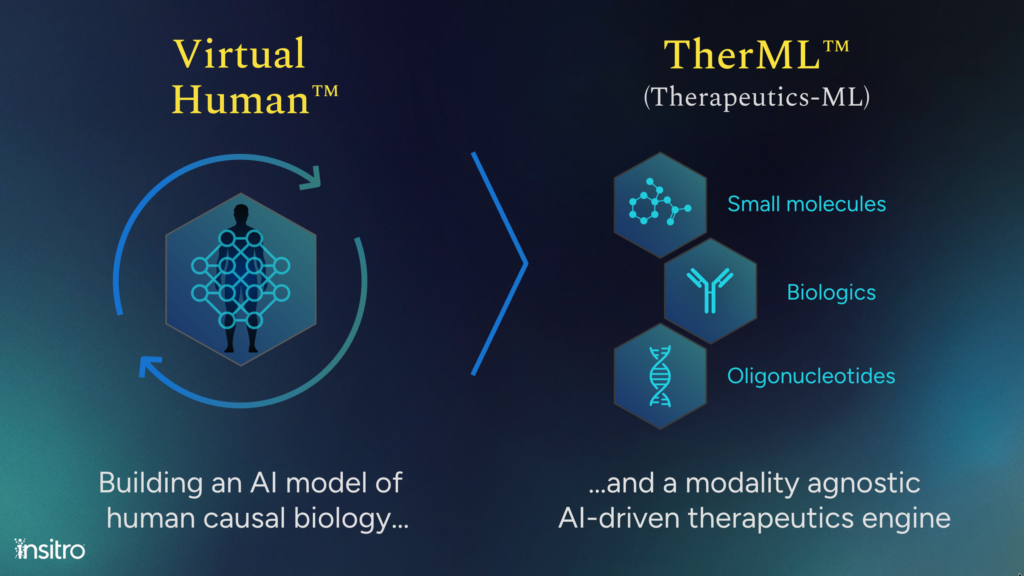
TherML is the therapeutic design layer of insitro’s end-to-end discovery platform, rapidly translating biological insight into optimally designed interventions.
Our discovery engine draws on genetic and phenotypic data from the world’s largest biobanks, complex imaging, and large-scale genetic perturbations to map how specific changes drive cellular phenotypes. These converge in the Virtual Human™, a unified computational representation of causal biology that allows us to understand not merely that a gene associates with disease, but how its perturbation propagates through biological systems to produce pathology.
Where the Virtual Human addresses what mechanism to target, TherML addresses how best to intervene.
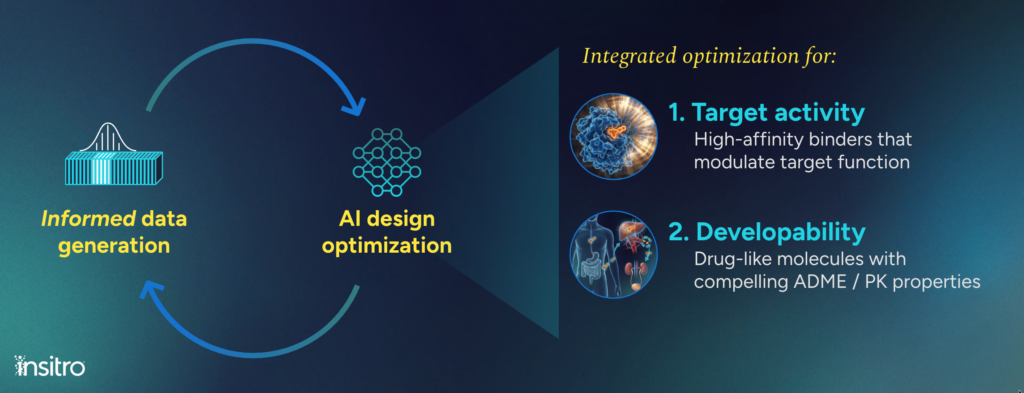
At the heart of TherML is a closed-loop active learning system of iterative data generation via differentiated experimental capabilities and AI-driven design cycles. Computational predictions guide experimental design, selecting experiments that maximize information gain. Subsequent experimental results refine the models—each cycle sharpens the next. The platform integrates directly with insitro’s automated laboratories, enabling continuous improvement in predictive performance that compounds over time.
In addition, rather than optimizing one trait at a time—potency, permeability, toxicity, etc. —TherML enables integrated optimization across two critical dimensions: Target Activity, ensuring high-affinity binders that precisely modulate target function, and Developability, ensuring drug-like molecules with the ADMET and pharmacokinetic properties necessary for clinical viability.
The molecules TherML designs are not optimized merely to be potent in a lab setting. They are built to navigate the complexities of human biology.
Over the past several years, we have established industry-leading internal capabilities in small molecules and oligonucleotides. Our recent small molecule partnership with Eli Lilly takes advantage of hundreds of thousands of proprietary data points and applies insitro’s machine learning expertise to create uniquely powerful ADMET models. In our BMS collaboration we are deploying the full range of our chemistry capabilities to deliver a small molecule drug to treat ALS. Against MASLD, our siRNA therapeutic candidate has shown strong efficacy as it rapidly advances toward First-in-Human studies.
This month, the addition of CombinAbleAI extends TherML’s foundational capabilities to include antibody design. CombinAble’s models allow for simultaneous optimization of potency and developability, the same principles that TherML enforces for small molecules now extended to biologics. The platform will be immediately deployed to several ongoing therapeutic programs.
In the coming months, we will share more about our platform’s specific capabilities and our progress in pushing the frontier of therapeutic design.